Pages

Showing posts sorted by relevance for query The Tenant. Sort by date Show all posts

Monday, August 29, 2011

The New York Times reviews "The Tenant"


THEATER REVIEW | 'THE TENANT'

Mystery Is Set for a Free-Range Audience

Bring comfortable shoes and a high threshold for frustration to theWoodshed Collective’s sprawling production “The Tenant,” the latest in a proliferating mini-genre of immersive-spookhouse mood pieces.
Emily Fishbaine
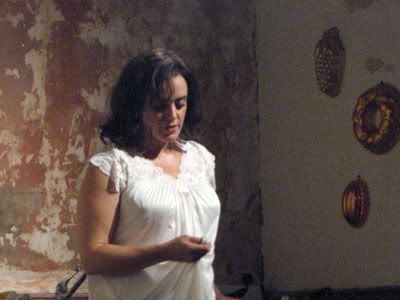
The Tenant In the Woodshed Collective's latest, audience members find vignettes in rooms of the West-Park Presbyterian Church. More Photos »
Multimedia

Related

Emily Fishbaine
Michael Crane in “The Tenant,” in which the landmark building is part of the event. More Photos »
As they are at the higher-profile “Sleep No More,” audience members are set loose on multiple stories of a converted building to construct macabre narratives as they see fit, stumbling onto staged vignettes along the way. But unlike “Sleep,” which supplies mandatory white masks, “The Tenant” (originally a 1964 Roland Topor novel, but better known from Roman Polanski’s 1976 film adaptation) allows lurkers and roamers to stare the performers in the face and vice versa, making the voyeuristic kick a bit more complicated. This also makes scuttling out of any given area more awkward when the scripted proceedings grow mannered or banal, but one manages. (“Why did you let them take the baby?” was about all I heard in one room.)
The audience has free rein to explore five floors of the landmark West-Park Presbyterian Church, on West 86th Street in Manhattan, which the directors, Teddy Bergman and Stephen Brackett, have converted into what’s meant to be a down-at-the-heel Paris apartment building. But “The Tenant” has a clear protagonist in its skittish title character, Trelkovsky (Michael Crane), who unravels psychologically shortly after moving into the unit where a suicide had recently taken place. It’s entirely possible to spend the entire two hours tagging along behind Trelkovsky, and Mr. Crane, who has some of Billy Crudup’s compact, cheekbony intensity, is worth the close attention.
But what’s the fun in following a straight narrative when a dramaturgical scavenger hunt awaits? Something interesting — or at least loud — always seems to be happening just barely within earshot, and it’s not just the creepy background music by Duncan Sheik (“Spring Awakening”) and David Van Tieghem. So off we go, in and around the invitingly banged-up building. (The production designer, Gabriel Hainer Evansohn, has worked wonders within with what appears to be a snug budget.)
Here we find some two dozen actors playing out scenes by six emerging writers. (Bekah Brunstetter and Steven Levenson are joined by Sarah Burgess, Paul Cohen, Dylan Dawson and Tommy Smith.) These scenes range from hypnotic to vapid, with the majority falling in a sort of humdrum middle ground. The action inevitably culminates in the sanctuary itself, after the entire cast has corralled the audience for a finale that is more ambitious than successful.
The stronger moments in “The Tenant,” those that make the case for this labor-intensive form of play making and watching, are those that take place in closer quarters. One inhabitant absent-mindedly bakes macaroons while delivering a monologue about videotaping naked men. A tiny room features a painting of Corduroy the Bear on the wall as well as a sad little checkerboard with bottle caps and eggshell fragments filling in as substitute pieces. A lone tooth sits in a bloody basin in Trelkovsky’s room.
You can’t make a fully successful play out of such eye-catching glimpses alone, or at least Woodshed Collective hasn’t. The more interesting stuff always seemed to be happening somewhere else the night I attended. But maybe I just kept missing it. That’s both the problem and the selling point of “The Tenant.”

Wednesday, August 17, 2011

West-Park and Woodshed: from the Westside Spirit


Tale of Madness at West-Park Presbyterian

Woodshed Collective uses historic church as backdrop for re-imagining of Polanski’s ‘The Tenant’
The final installment of director Roman Polanski’s so-called “Apartment Trilogy,” 1976’s The Tenant, isn’t as well known as Polanski’s earlier films Repulsion or Rosemary’s Baby. Starring Polanski himself as Trelkowski, a newcomer to a Paris apartment house who gradually goes insane under the scrutiny of his mysterious neighbors, The Tenant is enigmatic, haunting and sometime frustratingly oblique. So what better way to experience it than live, as part of Woodshed Collective’s ongoing love affair with installation theater?

An elaborate and intricate project, The Tenant, which opens Aug. 24 and is performed free of charge, boasts a script written by no fewer than six up-and-coming playwrights and original scoring from Duncan Sheik and David Van Tieghem, and is spread out over five floors of the historic West-Park Presbyterian Church parish house.
Woodshed Collective takes over West-Park Presbyterian Church for their production of The Tenant.
Woodshed Collective takes over West-Park Presbyterian Church for their production of The Tenant. Photo by Emily Fishbaine/ Subletting Theater
“I grew up in New York, and I have a sort of essential curiosity about what’s going on in the apartment next to you,” said Teddy Bergman, who, along with Gabriel Hainer Evansohn and Stephen Squibb, serves as Woodshed Collective’s artistic director. “And the source material represents a sort of nightmarish sense of that reality.”
The total immersion theatrical experience has been growing in popularity (and critical acclaim) since Woodshed Collective first started its installations with 2008’s 12 Ophelias, staged in McCarren Park Pool. In 2010, The Transport Group scored a massive success with their revival of The Boys in the Band, performed in an actual apartment; last year saw productions in buildings as varied as the Goethe-Institut (Hotel Savoy) and Hudson Hotel (Green Eyes). And, of course, there was this past spring’s site-specific breakthrough, Punchdrunk’s critical and popular hit Sleep No More, a disorienting immersion into the world of Hamlet staged in a Meatpacking District warehouse.
Far from being envious or feeling territorial, Bergman and company are rooting for more experiences like that.
“It’s exciting that there’s more installation and site-specific work going on here,” Bergman said. He praised companies that “try to invest new spaces with theatrical power, and then try to reclaim theatrical power for a new audience and put them in touch with what’s remarkable about the form.”
Surely Woodshed Collective’s The Tenant is one of the more appropriate pieces with which to experience the full force of theatrical power. Just as The Boys in the Band put audience members in the same room as the sozzled characters, so, too, do Bergman and his playwrights include the audience in the increasingly fragmented world of Trelkowski and his neighbors.
“The story kind of illustrates the sort of breakdown of the modular society of this building, and all of the flaws inherent in it,” Bergman said, harshly highlighting “people’s essential mistrust of one another and people’s lesser instincts hiding just below the surface. That story, to me, is a very exciting one to tell in an installation context. When we’re asking people to walk around and look and explore, it’s a fun mirror to hold up to the organism of the audience.”
Mounting a show written by six different playwrights, all with different voices, was not the headache it might at first seem. “The starting point for most of the writers was in the source material,” Bergman said—material that included the original novella by Roland Topor that Polanski adapted for his film. None of the playwrights was given an assignment; instead, they were asked to list the characters they’d prefer to write.
“And there was some crossover, but it kind of worked out wonderfully,” Bergman said with a laugh. “Of course, we were prepared for everyone to fight over the landlord character.”
The worry that half a dozen different voices might clash instead of mesh is rendered moot by what those half-dozen voices are working on. “Some of that got ironed out over the course of drafts and the course of the process,” Bergman said. “There is a sort of sense about genre that they’re all tapping into but, I think, in certain ways, where stylistic divergences appear makes sense in the piece. Each character is invested with an author’s point of view. It’s form following content. It’s set in an apartment building with many lives being led, and we want to give a distinct voice to all those lives. I just think it’s so thrilling to encounter multiple voices in that context, which to me, in certain ways, is a more accurate representation of those lives.”
Telling a story as layered and complex as that of The Tenant needed just the right space, and Woodshed Collective hit the jackpot with West-Park Presbyterian Church. “We wanted something with multiple floors and the ability to see from one room to another with a kind of circuitous traffic pattern, so you feel kind of in the maze of the building,” Bergman said. “This building really has it.”
West-Park is no stranger to the theater, either. Long a home to Upper West Side theater companies like Riverside Shakespeare Company and Frog and Peach, West-Park’s pastor, Robert Brashear, felt no qualms about hosting such a sprawling theatrical endeavor. “When they approached us, we were really in a pretty empty state,” Brashear said. “We were closed for approximately three years, and came back here and were reclaiming what was some seriously damaged space. After landmarking last year, we had to do this ourselves. And with a parish house with significant water damage, the work that Woodshed is doing helps us further down the path. We’ll have the benefit of significant parts of our restoration accomplished.”
The arts have provided a major stepping stone for the restoration of West-Park’s buildings. In addition to the repair work that Woodshed Collective has necessitated, a June concert for victims of the Japanese tsunami helped restore some of the church’s bathrooms, and a Three Graces production prompted the church to bring the space up to code for Actors’ Equity.
That rough-around-the-edges aesthetic of West-Park is a perfect match for both Woodshed’s immersive aesthetic and the tone of The Tenant. As Bergman said, “Because both metaphorical and actual urban decay are topics in the piece, an historical building like this, and one that definitely shows its wear and tear on the surface, was essential.” Also essential, no doubt, will be return trips to West-Park for the chance to follow another strand in the web that Bergman and company have so carefully woven.

Friday, August 26, 2011

The New York Press on West-Park and Woodshed


Thursday, August 25,2011

Tale of Madness at West-Park Presbyterian

Woodshed Collective uses historic church as backdrop for re-imagining of Polanski’s ‘The Tenant’

By Mark Peikert
Photo by Emily Fishbaine/ Subletting Theater
The final installment of director Roman Polanski’s so-called “Apartment Trilogy,” 1976’s The Tenant, isn’t as well known as Polanski’s earlier films Repulsion orRosemary’s Baby. Starring Polanski himself as Trelkowski, a newcomer to a Paris apartment house who gradually goes insane under the scrutiny of his mysterious neighbors, The Tenant is enigmatic, haunting and sometime frustratingly oblique. So what better way to experience it than live, as part of Woodshed Collective’s ongoing love affair with installation theater?
An elaborate and intricate project, The Tenant, which opened Aug. 24 and is performed free of charge, boasts a script written by no fewer than six up-and-coming playwrights and original scoring from Duncan Sheik and David Van Tieghem, and is spread out over five floors of the historic West-Park Presbyterian Church parish house.
Woodshed Collective takes over West-Park Presbyterian Church for their production of The Tenant.
“I grew up in New York, and I have a sort of essential curiosity about what’s going on in the apartment next to you,” said Teddy Bergman, who, along with Gabriel Hainer Evansohn and Stephen Squibb, serves as Woodshed Collective’s artistic director. “And the source material represents a sort of nightmarish sense of that reality.”
The total immersion theatrical experience has been growing in popularity (and critical acclaim) since Woodshed Collective first started its installations with 2008’s 12 Ophelias, staged in McCarren Park Pool. In 2010, The Transport Group scored a massive success with their revival of The Boys in the Band, performed in an actual apartment; last year saw productions in buildings as varied as the Goethe-Institut (Hotel Savoy) and Hudson Hotel (Green Eyes). And, of course, there was this past spring’s site-specific breakthrough, Punchdrunk’s critical and popular hit Sleep No More, a disorienting immersion into the world of Hamlet staged in a Meatpacking District warehouse.
Far from being envious or feeling territorial, Bergman and company are rooting for more experiences like that.
“It’s exciting that there’s more installation and site-specific work going on here,” Bergman said. He praised companies that “try to invest new spaces with theatrical power, and then try to reclaim theatrical power for a new audience and put them in touch with what’s remarkable about the form.”
Surely Woodshed Collective’s The Tenant is one of the more appropriate pieces with which to experience the full force of theatrical power. Just as The Boys in the Band put audience members in the same room as the sozzled characters, so, too, do Bergman and his playwrights include the audience in the increasingly fragmented world of Trelkowski and his neighbors.
“The story kind of illustrates the sort of breakdown of the modular society of this building, and all of the flaws inherent in it,” Bergman said, harshly highlighting “people’s essential mistrust of one another and people’s lesser instincts hiding just below the surface. That story, to me, is a very exciting one to tell in an installation context. When we’re asking people to walk around and look and explore, it’s a fun mirror to hold up to the organism of the audience.”
Mounting a show written by six different playwrights, all with different voices, was not the headache it might at first seem. “The starting point for most of the writers was in the source material,” Bergman said—material that included the original novella by Roland Topor that Polanski adapted for his film. None of the playwrights was given an assignment; instead, they were asked to list the characters they’d prefer to write.
“And there was some crossover, but it kind of worked out wonderfully,” Bergman said with a laugh. “Of course, we were prepared for everyone to fight over the landlord character.”
The worry that half a dozen different voices might clash instead of mesh is rendered moot by what those half-dozen voices are working on. “Some of that got ironed out over the course of drafts and the course of the process,” Bergman said. “There is a sort of sense about genre that they’re all tapping into but, I think, in certain ways, where stylistic divergences appear makes sense in the piece. Each character is invested with an author’s point of view. It’s form following content. It’s set in an apartment building with many lives being led, and we want to give a distinct voice to all those lives. I just think it’s so thrilling to encounter multiple voices in that context, which to me, in certain ways, is a more accurate representation of those lives.”
Telling a story as layered and complex as that of The Tenant needed just the right space, and Woodshed Collective hit the jackpot with West-Park Presbyterian Church. “We wanted something with multiple floors and the ability to see from one room to another with a kind of circuitous traffic pattern, so you feel kind of in the maze of the building,” Bergman said. “This building really has it.”
West-Park is no stranger to the theater, either. Long a home to Upper West Side theater companies like Riverside Shakespeare Company and Frog and Peach, West-Park’s pastor, Robert Brashear, felt no qualms about hosting such a sprawling theatrical endeavor. “When they approached us, we were really in a pretty empty state,” Brashear said. “We were closed for approximately three years, and came back here and were reclaiming what was some seriously damaged space. After landmarking last year, we had to do this ourselves. And with a parish house with significant water damage, the work that Woodshed is doing helps us further down the path. We’ll have the benefit of significant parts of our restoration accomplished.”
The arts have provided a major stepping stone for the restoration of West-Park’s buildings. In addition to the repair work that Woodshed Collective has necessitated, a June concert for victims of the Japanese tsunami helped restore some of the church’s bathrooms, and a Three Graces production prompted the church to bring the space up to code for Actors’ Equity.
That rough-around-the-edges aesthetic of West-Park is a perfect match for both Woodshed’s immersive aesthetic and the tone of The Tenant. As Bergman said, “Because both metaphorical and actual urban decay are topics in the piece, an historical building like this, and one that definitely shows its wear and tear on the surface, was essential.” Also essential, no doubt, will be return trips to West-Park for the chance to follow another strand in the web that Bergman and company have so carefully woven.

    Friday, August 5, 2011

    The New York Times writes about Woodshed


    The New York Times' Woodshed article...


    No Space Too Dilapidated for a Show

    Guy Calaf for The New York Times
    Top, Evan Enderle and Teddy Bergman rehearsing “The Tenant.” More Photos »
    FOR about three years the West-Park Presbyterian Church, at the corner of 86th Street and Amsterdam Avenue, sat abandoned as architects, congregants and preservationists squabbled over a plan to build condominiums above the rosy, Romanesque Revival structure. When landmark designation last year quashed development plans, worshipers returned to a building much in need of repairs. In the parish house that abuts the chapel, paint peels, damp patches spread, and musty odors rise from the basement.
    Multimedia
    Guy Calaf for The New York Times
    From left, Teddy Bergman, Stephen Squibb, Emily Fishbaine, Jocelyn Kuritsky and Carl Faber of the Woodshed Collective. More Photos »
    Yet for the Woodshed Collective — an ambitious New York theater company with a commitment to low-budget, site-specific productions (past locations have included an empty swimming pool and a ship) — West-Park’s dilapidated state has been the answer to a prayer. Walking through a meeting room in the church, Gabriel Hainer Evansohn, one of the collective’s three artistic directors, ran his hand along a rip in the wall that revealed layers of faded paint. “Recreating this would be so expensive and difficult,” he said. “Actually it would be impossible.”
    On Wednesday the company will begin previews of “The Tenant,” a theatrical installation that uses West-Park as the setting. It is based on a 1964 novella by Roland Topor, later adapted by Roman Polanski into a 1976 movie that flopped. Teddy Bergman, another of the collective’s artistic directors, described the source material as “French, alienated, midcentury, Left Bank moodiness.”
    The story involves a Polish man, Trelkovsky, who takes over a Paris apartment — “two gloomy rooms, with no kitchen” — that had been occupied by a woman who committed suicide. As the grim building and irascible neighbors press in on him, Trelkovsky experiences a crisis of identity: He begins to dress as the dead woman and then replicates her fatal plunge.
    Woodshed will use all five floors of the parish house as well as the church chapel to recreate and expand on the events in the novella. The collective has gathered six playwrights — including emerging writers like Bekah Brunstetter and Tommy Smith — to draft a script for the inhabitants of each of the fictional building’s apartments. Duncan Sheik, who won two Tony Awards for his work on the musical “Spring Awakening,” is providing the music for the production, which opens on Aug. 24 and runs through Sept. 17.
    With so much sinister action and so many stairs, the show is not for the faint of heart or weak of quadriceps. Audiences can follow one set of characters throughout an evening, or hopscotch from floor to floor, somewhat in the manner of the current Punchdrunk hit “Sleep No More.” But unlike Punchdrunk, whose top ticket price can run to $95 or more, Woodshed presents its annual project free. Though, just as at a church service, a collection plate is passed after each performance.
    The opportunity to perform at the church arose when the Rev. Dr. Robert L. Brashear, West-Park’s pastor, donated use of the space to the collective. It was part of a commitment to reinvent the church as a community center “for social and spiritual renewal,” Mr. Brashear said.
    Woodshed originated when Mr. Bergman, Mr. Evansohn and the collective’s third artistic director, Stephen Squibb, met through drama classes at Vassar. Their initial idea was to form a troupe that would take an innovative approach to classic plays. After graduating in 2005 they decided to focus on site-specific performance. In 2008 they presented Caridad Svich’s “Twelve Ophelias” in a drained swimming pool in Williamsburg, Brooklyn, and in 2009 they staged an adaptation of Herman Melville’s “Confidence-Man” aboard the Lilac, a decommissioned Coast Guard vessel moored in the Hudson.
    Creating site-specific theater poses challenges: securing spaces, making them safe for audiences, adapting sound and lighting equipment to fit untraditional environments. Anne Hamburger, the founder and artistic director of En-Garde Arts, the site-specific group that during the 1980s and ’90s performed in New York on piers, in parks, at an abandoned nursing home and on the streets of the meatpacking district, recalled: “It’s very complex in terms of logistics and production management. You can’t fight a site. If you try, it will win.”
    Vallejo Gantner, the artistic director of Performance Space 122 in the East Village, which presented “Hotel Savoy” at the Goethe-Institut last year, said of site-specific work: “The predictability is much less. It’s great in terms of the excitement you feel about the piece, but it becomes a much more unwieldy beast.”
    The Woodshedders have experienced that firsthand. Poor acoustics marred “Twelve Ophelias,” and uncooperative weather rained out several performances of “The Confidence Man.” In preparing “The Tenant” the crew spent two weeks just clearing away debris. But for these young men, who discussed their hopes for the show on the church’s crumbling patio, the difficulties are mitigated by the opportunities that nontraditional spaces offer.
    The structure of the West-Park parish house has determined various creative decisions, influencing both script and staging. West-Park “is a character in the show, it’s a collaborator, it gets a seat at the table,” Mr. Squibb said. “As we’ve gotten to know it, it’s had different opinions of things. We wanted to use the bell tower, but it decided we didn’t get to, because it was overrun with pigeons.”
    The building’s seat at the table is one of about 90 chairs, for the cast, crew, writers and designers, all of whom work free. “The Tenant,” which has a budget of under $100,000, according to the artistic directors, is Woodshed’s most ambitious undertaking: eight separate plays that must unfurl with meticulous timing as they intersect with one another. Sheaves of spreadsheets have been printed, and technical rehearsals were estimated to last three weeks. The prospect is enough to make most theater artists head for the nearest black box and stage some comforting Chekhov one-acts.
    Still, Woodshed’s Web site describes its mission, in part, as creating “a genuine sense of wonder” by providing theatrical playgrounds through which audiences can wander freely, selecting their own experiences as they move from scene to scene, something a black box cannot offer.
    Mr. Squibb said he was baffled as to why more theater companies don’t pursue the site-specific route. “There are so many incredible spaces in New York,” he said, “a boat on the Hudson, a giant Robert Moses pool, a church building that’s been empty for three years. And you want me to rent a theater and build a bunch of stuff and then throw it out afterward? It just doesn’t make sense to me.”
    This article has been revised to reflect the following correction:
    Correction: August 4, 2011
    An earlier version of a caption in this article reversed the names of Jocelyn Kuritsky and Emily Fishbaine of the Woodshed Collective.

    Friday, October 7, 2011

    What it is, is life


    10/6
    A full day begins with Mark. He’s got sound equipment in several places, wants to bring it all to West-Park. Can fix us up with a good system. He’d like to be the in house sound guy, free for us and non-profits who are our partners. He’d charge straight rentals to others, split the fee swith us . He could also work out recording and even has a projector he could let us have. Sounds like a good deal. He also borrows a hammer, looks for some nails to repair one of our sign boards. 
    Teddy is sitting in the sanctuary. The load out continues. Watching it all come down is depressing after the excitement of watching the Tenant spaces take shape over the weeks and living here all these months. Mark comes back in, sign repaired. 
    Mim, Ted, Hope, Sarah and Danielle all come togther in the office to meet with Lisa  and begin to put together a strategy to raise the money necessary to get a new boiler. We need to get the final dollar figures firm so we can know what we need. 
    Danielle goes with Sarah up to Mc Alpin to work on preparing the space for the gallery opening that will happen tonight.
    Hope and I talk about Occupy Wall Street. The sense that something global is happening. We’re saddened by the silence of the church in the face of what feels to be a significant moment. The church seems to be caught up in its own self absorbed concerns whether it’s Louisville or New York City. Like somewhere along the line, it bought into the idea, with resignation or even cynicsm that one has to understand the way things are and make the best of it. That survival means acquiescing to where money and power seems to be. Making a prioiri acquiescence to the powers of domination which doesn’t really work anyhow. It’s causing her to raise theological questions. There has to be another, a prophetic word somewhere. The rest of it all is already over. But then we’ve known that. Presence. Relationship. Authenticity. That’s what counts. 
    Derek from Grace Church comes by, wants to know if we’ve read his letter. If they could even rent for Christmas. Jocelyn stops by, she was the disabled girl in the Tenant. Also a  member of the Collective. Helped do casting. She’s opening in a new avant garde play by Mac Wellman tomorrow night. on Dixon Place downtown . Mr. Martin, the slightly eccentric paino tuner who shows up at random times at our home to tune the piano has come in. Begins to check out our popup baby grand. Tells me it’s a Selmer and that he used to work for them on 57th across from Carnegie Hall. Where he learned his trade. 
    Someone comes in with the idea for a dramatic production that coud be punctuated with organ music. I explain that the Austin is presently out of service but Mark says with amplicifaction our classic Hammond could sound (almost) like a pipe organ. Sarah has returned with James, the little guy she nannies.  Boxer Mike is back form Sweden with stories. And just tell him how he can help. Maybe clean out the front where stuff is all in a jumble? We’ll figure that out when Woodshed is finally all out. 
    Hope has observed all this. Thinks it’s great. This is her church. What it is, is life. And that’s enough.
    We just have to find a way to get enouhg money to keep it going.
    I return shortly after six to see the gallery opening. It’s a show called Telling the Truth. Simple installations by Joe Sturm, Ben Valentine and David Vu curated by Vincent Tiley. The cafe left over from the Tenant is  now our reception area. We’re using some of RL’s wine.  I tell Ben that his mylar works remind me of the mylar blankets we used to use for homeless people in cold weather.  He likes that.
    Our gala committee meets. We talk about how it’s all got to be coordinated with the fundraising for the boiler. Ted has some doubts about the whole boiler/fundraising process. Do we need a plan B? A plan C? We have to  find a way to include music. And wonder. And yes, the questions raised by Occupy Wall Street. I see Leila and Berik leaving from  visiting the opening. 

    Our meeting has  ended. The opening is over. Cardboard beds are being made outside. In the doorways. Above the steps. 

    Tuesday, January 10, 2012

    Thinking of wolves and sheep


    1/9
    Danielle is finally back. Hallelujah! Rafael needs to talk to me about security measures. Needs my backing to enforce the list. Keep people away from restricted spaces. Susie the social worker is with him. I see Jeff and invite him over. And talk about how a union security person and a social worker on call are a necessity. Won’t do it without.
    Out on the steps, a man is asleep. I tell him he’s got to get up. He says sure, doesn’t move. I come back again, and he gets angry. Man why you always fuckin’ with me? Why you can’t leave me alone? This a church, man, lemme be.
    Look up the street sir, you see anyone else asleeep on the steps?
    Nah man, them other churches, let people sleep inside  there, you won’t even let me be on the steps. You keep fuckin’ with me. 
    I want to say, Dude, I got like a 100 right inside. But I say, And they all went through a program to get there. Time to go. He grumbles some more, goes. Gary is sitting in the south doorway, waiting for Anthony. He gives me a thumbs up. I try to explain this all to Jeff. If someone's asleep there during the  day, there's somethingelse going in as well/
    Later, I find Gary asleep. Gary, I can’t make someone else leave and let you sleep here. 
    Just waiting for Anthony.
    You got a place to go, right?
    Yeah, just waitin’.
    Stay awake, ok?
    He nods.
    I walk Jeff across the street to get a coffee and a tea and explain that tonight is going  to be different. Kevin has his show. We can’t host spokes tonight and Kevin has his immersive experience up until 11PM. We’ll make it work.
    Martin drops by to talk before his flamenco troupe heads out to Portland. He’ll be meeting with Amanda while he’s there. He had a good rehearsal last night. Anxious to keep our negotiations going.  
    Finally Danielle and I have a chance to talk. Much has gone on while she’s gone. Much to catch up on. The phones keep ringing, hers, mine, the office. The presence of #ows and their large footprint is a bit overwhelming. 
    When it gets too crazy, I just go out and sweep. 
    Micah from Kevin’s production is here to do set up work. They’ll be quickly setting the stage for their night production. Lights to hang, projections to set up, quick sets to construct.
    In the late afternoon, Kevin is trying to get his performance up and ready. Meeting in the session room. Too much noise above in Mc Alpin. The twins are screaming. I go upstairs, a young woman is swinging them around, Dan hanging out nearby. I tell them there’s a show being prepared and they’ve got to calm it down. I assume she’s an occupier.
    Later in the sanctuary, she says, with a half smile, There’s the mean man who yelled at me. I smile back and say that I’m not a mean man and start talking to her like she’s an #ows, trying to explain that there’s a show and it turns out she’s actually with the show. Her name’s Heather. The twins’ mother is Heather.It’s confusing. 
    Dan tells me Heather (mom) is at the doctor’s and he’s got the kids. And they’re heading to Brooklyn and he’s waiting for Berik who wants to hire him to DJ. And that’s the crazy afternoon, actors and #owsers and some who are both and church people and artists all mixed up. Can’t tell one from the other. And Berik finally arrives, brimmign with ideas for fashion shows and art sales and its getting late. 
    A steady stream keeps coming looking for spokes, Send them down to the Brecht Institute where they’ll be tonight. 
    I head for a pint and a little ‘bama-LSU before Kevin’s run through.
    The Den is an intriguing performance to say the least. Aligned with the full moon. Audience members gather at Soldier McGee pub down Amsterdam and are brought one by one into the space. You start with a mad professor in the chapel, at the pulpit, lecturing on graphologic, phonemic systems of writing, symbolism, meaning. Then you’re led up to the 4th floor gym up the back stairs. Looking at the peeling, blistered paint, I remember trips up those stairs and the Tenant. There are projections of spring, actors on all fours howling, playing wolves. Led down to Mc Alpin. Its winter. Sheep in the middle. The wolves attack the sheep. Down into the Session room, the hospital. A foot washing, cleansing ritual. Then disorienting night vision goggles are put on and you’re led by hand into the sanctuary where the wolves have returned and there’s a crucifixion/resurrection? scene with a sheep/lamb? and then a nude woman appears, hands you a flower and leads you out to Amsterdam. Hmmm.
    I see what he’s got going on here. It’s like the audience member is an initiate. It’s ritual space. (Back to you, Bill, you should be here.) I leave to catch the end of the game. (LSU’s got nothing.All ‘bama.)
    And come back at 11:30. Occupiers lining the steps, waiting. Kevin’s about to take his last audience member through. As the journey begins, he invites the occupiers in from the cold. I sit in the chapel, half expecting Trelkovsky and the Tenant cast to appear and he leaps to his death one more time. But it’s wolves, a lamb and a naked woman with a flower. And as the audience member exits, the cast applauds.
    I have to ponder this. Over 30 cast members perform for an audience of one, one at a time. Who is whom? Roles, proportions reversed. Who is the perfomance for? I love the counterintuitivity of it all. Turms out other troupes are playing with this form. One of Kevin’s crew was with the Shakepseare/Hitchcock immersion Sleep No More. Kevin was drawn here by the Tenant. Glad we can do this now. Won’t be possible later.
    Occupiers help Kevin load out. 
    #ows dealing with issues. People keep psuhing me to cut separate deals, make exceptions. Some make reasonable moral arguments.Though Jason (the angry one, not the thoughtful one) is getting aggressive, getting personal. I tell him, them, I can’t do it. Can’t choose one over the other. Has to be  a community process. I won’t subvert that. Jason (angry) tells me it hasn’t been democratic around here. Clearly part of a group of anarchists who want to overthrow Jason (thoughtful) and Jeff and Stan. 
    Freedom for one is oppression for another. I still can’t understand why a thief or abuser (there are both) would want to jeopardize the whole community. I think I just answered my own question. People continue to press me. I keep pushing it back to community. I’m thinking about wolves and sheep.


                                           + + + +


    Read dnainfo.com's article about our new boiler: http://www.dnainfo.com/20120110/upper-west-side/westpark-presbyterian-churchs-new-boiler-boosts-temps-spirit